
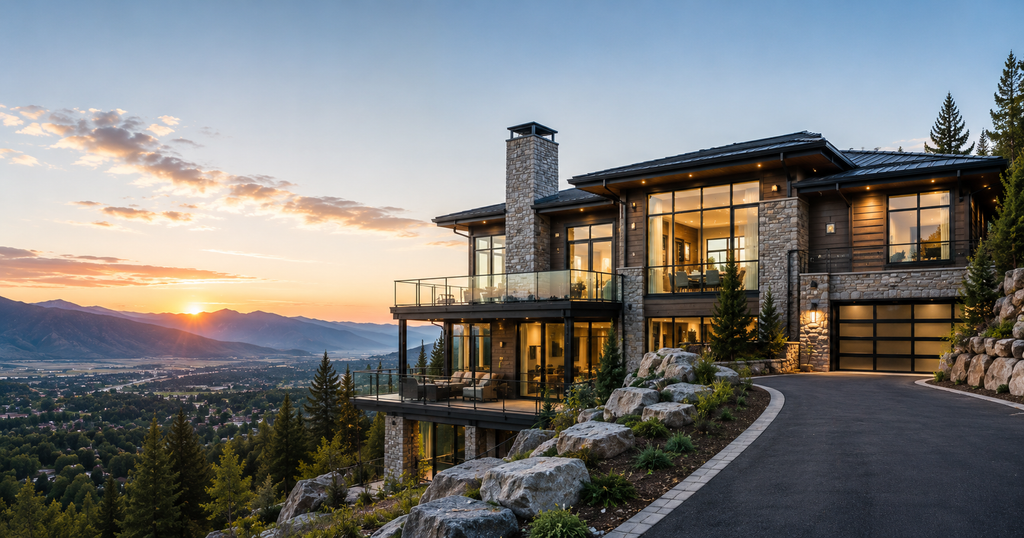
Building on a challenging lot? Learn how slope, soil, drainage, utilities, and site access can impact your custom home design, budget, and build.
You find the property and immediately see the possibilities.
Mountain views. Privacy. Mature trees. Maybe a dramatic hillside overlooking the valley.
It feels like the perfect place to build your custom home.
But before purchasing land based on the view alone, there’s another question worth asking:
How difficult will it actually be to build here?
The property underneath a custom home can influence nearly every aspect of the project—from the home’s design and foundation to excavation, utilities, drainage, construction access, timeline, and budget.
A challenging lot doesn’t necessarily mean you shouldn’t build there. In fact, difficult properties can become the setting for some of the most distinctive custom homes.
The key is understanding the challenges before you buy.
Here are some of the biggest factors prospective custom-home owners should consider when evaluating land.
1. Start With the Slope
Sloped lots can create incredible architectural opportunities.
They may provide unobstructed views, walkout basements, dramatic decks, multi-level designs, and layouts that naturally follow the landscape.
But slope also affects construction.
A steep property may require additional excavation, specialized foundations, retaining structures, drainage solutions, or more complex construction access.
Instead of immediately viewing slope as either good or bad, think of it as a design and construction factor.
The right question is:
What type of home makes sense for this property?
Trying to force a floor plan designed for flat ground onto a steep hillside may create unnecessary complexity and expense.
Designing around the land can produce a much better result.
2. Understand What’s Under the Ground
The surface only tells part of the story.
Soil conditions can significantly influence how a home must be engineered and constructed.
Different properties can contain varying combinations of soil, clay, rock, groundwater, fill, or other conditions that affect foundation requirements.
Depending on the project and location, professional soil evaluation or geotechnical analysis may be necessary before final engineering decisions are made.
Discovering difficult conditions before purchasing a property gives you far more flexibility than discovering them after the design is complete.
3. Don’t Overlook Drainage
Water is one of the most important considerations on any building site.
Where does rainfall go?
Where does snowmelt travel?
Does water naturally move toward or away from the proposed building area?
How will grading affect neighboring areas of the property?
Proper drainage planning can influence grading, foundations, retaining systems, landscaping, and long-term moisture management.
On sloped properties, this becomes particularly important because gravity naturally directs water downhill.
A beautiful site can still become a problematic building location if water management isn’t considered from the beginning.
4. Find Out How Utilities Will Reach the Home
A piece of land may look ready to build on while still requiring substantial infrastructure.
Before buying, investigate access to:
- Electricity
- Natural gas or propane
- Water
- Sewer or septic systems
- Internet and communications
The distance between existing utilities and the proposed home can affect project costs.
Properties outside established neighborhoods may require wells, septic systems, utility trenching, or other infrastructure before construction can begin.
Understanding those requirements early can help you develop a more realistic total project budget.
5. Think About Construction Access
Here’s something many homeowners don’t consider:
Can construction equipment actually reach the building site?
Building a custom home requires more than passenger-vehicle access.
Depending on the project, the site may need to accommodate:
- Excavators
- Concrete trucks
- Cranes
- Material delivery trucks
- Telehandlers
- Framing deliveries
- Waste containers
- Trade vehicles
A narrow driveway, steep grade, tight turn, overhead obstruction, or limited staging area can complicate construction.
Access doesn’t necessarily make a property unsuitable, but it should be considered before construction planning begins.
6. Consider How the Land Affects the Foundation
The foundation connects your home to the property beneath it.
On straightforward sites, foundation construction may be relatively conventional.
On challenging terrain, the structural solution can become more complex.
Slope, soil conditions, frost considerations, drainage, structural loads, and architectural design can all influence foundation engineering.
This is one reason it’s valuable to involve experienced construction professionals early.
The home’s architecture and the site’s structural realities should work together rather than being addressed separately.
7. Look Beyond the View When Positioning the Home
The best location for a house isn’t always the most obvious location on the property.
Views certainly matter, but so do:
- Sun exposure
- Wind
- Privacy
- Driveway access
- Drainage
- Grading
- Utility connections
- Outdoor living areas
- Construction access
Sometimes moving a home slightly on the property can dramatically improve both its construction feasibility and everyday livability.
Thoughtful site planning considers the entire property rather than simply choosing the highest point or best initial view.
8. Understand Local Building Requirements
Owning land doesn’t automatically mean you can build anything you want on it.
Local requirements may affect:
- Setbacks
- Building height
- Lot coverage
- Driveway placement
- Utility connections
- Septic systems
- Grading
- Fire access
- Easements
Properties may also have HOA requirements, recorded restrictions, or other limitations.
These should be investigated before purchasing land or committing to a specific home design.
9. Build the Home for the Property
One of the biggest advantages of custom construction is the ability to design around the land.
A challenging site can inspire architectural features that wouldn’t make sense elsewhere.
A hillside might become a walkout lower level.
A dramatic view could inspire a wall of windows.
Changes in elevation might create interesting multi-level living spaces.
A wooded property may influence window placement and outdoor living areas.
Rather than fighting the property, great custom-home planning uses its characteristics as part of the design.
10. Bring Your Builder Into the Conversation Early
One of the smartest things you can do before buying land for a custom home is involve construction professionals early.
A builder can look at a property through a very different lens than a prospective homeowner.
Instead of simply seeing the scenery, experienced construction professionals are thinking about:
- Access
- Excavation
- Foundations
- Structural requirements
- Material delivery
- Buildability
- Sequencing
- Potential challenges
Identifying these considerations before purchasing land can help you make a much more informed decision.
A Difficult Lot Can Become an Incredible Home
Some of the properties that require the most thoughtful planning can produce the most memorable homes.
The goal isn’t necessarily to avoid challenging land.
It’s to understand what you’re buying.
When the site, architecture, engineering, and construction strategy are considered together, difficult terrain can become an opportunity rather than an obstacle.
At Johnson Revolution Construction, our experience spans custom homes, structural framing, log and timber construction, commercial projects, and complex building solutions. We believe identifying challenges early and developing practical solutions is one of the most important parts of turning an ambitious idea into a successful project.
Thinking About Buying Land for a Custom Home?
Before committing to a property, bring experienced construction professionals into the conversation.
Johnson Revolution Construction can help you evaluate your goals, identify potential construction considerations, and begin developing a realistic path from raw land to finished home.
Because the right custom home doesn’t begin with the floor plan.
It begins with understanding the land beneath it.